

Book Available on Amazon
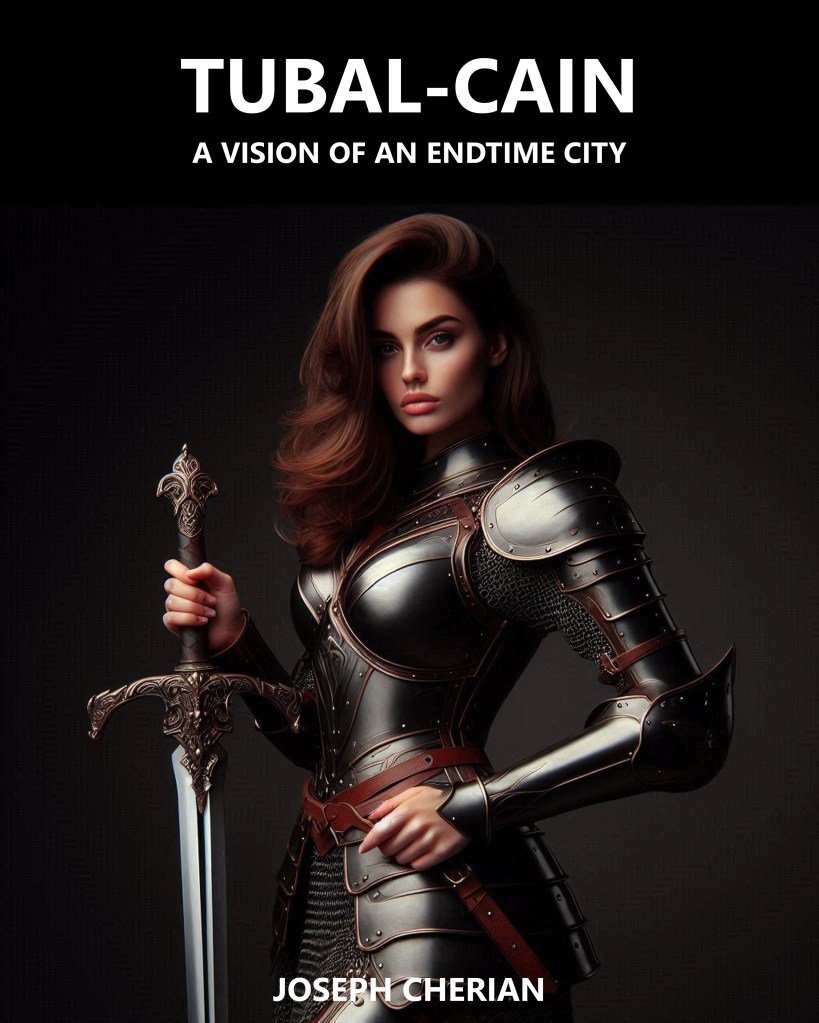
Tubal-Cain: A Vision of An Endtime City is a prophetic novel that entwines biblical echoes, apocalyptic forewarnings, and human drama into a story that is both ancient and urgent for today.
The story begins with Gabriel, a man from our modern world, mysteriously transported across time into the antediluvian age. Awakening in a land alive with legends and brimming with impending doom, he is drawn into the city of Tubal-Cain – a place of power, idolatry, and corruption, ruled by despotic sovereigns and guided by priests who serve demonic powers masquerading as gods.
At first an outsider, Gabriel becomes entwined with the life of the city. He befriends Methuselah, respects the prophetic voice of Noach, and builds deep ties with Zillah, whose loyalty, wavering faith, and passionate love for him form the emotional heart of the narrative. He also witnesses the intoxicating grandeur of Tubal-Cain’s rulers – Cyrenius, Milcah, Zimri – who blend political cunning with spiritual deception, leading the masses into enforced worship of Ishwara and eventually into the horror of child sacrifice.
As Gabriel trains as a warrior in the elite Purple Legion, he witnesses not only battles and rebellions but also the frightening transformation of a civilization sliding deeper into darkness. Rebellions arise, famines devastate the land, beasts of prey swarm the city, and cosmic phenomena shatter the skies. Through it all, Tubal-Cain grows more hardened, its people enslaved not only by political power but by their own lust for spiritual intoxication.
The novel does not merely recount calamities; it paints the vivid cost of compromise. Some, like Jaazaniah and Milcah, struggle with divided loyalties between truth and the sovereign’s demands. Others, like Zillah, embody humanity’s conflict between desperate love of life and longing for eternal hope. Zillah’s relationship with Gabriel culminates in one of the most poignant portrayals of human passion and despair – her unwillingness to let him go, even as he is borne away, mirrors the agony of a world clinging to the temporal while eternity calls.
Tubal-Cain is more than a city; it is a symbol, an archetype of every human civilization that exalts itself against its Maker. The child sacrifices, the grand festivals, the seductive visions of “galactic visitors,” and the iron hand of rulers intoxicated by their own authority all serve as prophetic parallels to today’s world – where science, politics, and spirituality conspire in a counterfeit unity, even as divine warnings thunder unheard.
The climax comes with the Deluge: fountains breaking forth, floods submerging nations, the ark sealed, and multitudes perishing. Gabriel, torn between his love for Zillah and his divine calling, is borne away in a golden chariot – back to his own age – while the woman he loved so deeply stands submerged in the rising waters, holding his sandals to her chest in a final, unforgettable image.
But the story does not end with her loss. Back in his world, Gabriel entrusts his testimony to Joe, his modern-day friend, commissioning him to transcribe and publish the narrative. This framing device ties the novel to us directly: what Joseph’s protagonist saw in Tubal-Cain is not dead history but a prophetic warning.
The book is thus both a gripping narrative and a prophetic vision. It dramatizes humanity’s relentless descent when truth is spurned, it unveils the horror of judgment when evil matures, and it leaves the reader haunted by one pressing question: if Tubal-Cain perished for its sins, what of our own endtime city — the world today?
Tubal-Cain: A Vision of An Endtime City is more than entertainment. It is a revelation, a warning, and a call to awaken before history repeats its catastrophic end.
“This is book that combines the historicity of Ben-Hur, the awe of Jurassic Park, and the magic of Avatar.”
 Prepare The Way Of The Lord!